






Red Fern Farm Selected Chestnut Seeds (very heavily Chinese chestnut genetics, from named 'Mother' trees and their offspring 'Up and Coming' trees)
Regular price
$22.50
Sale
Note on chestnut genetics:
Before we go any further, as you can see, we have two different options for Red Fern Farm chestnut genetics. This one is more Chinese. The other has some more American in it.
When we are talking about Chinese and American chestnut genetics, the broad strokes of what you need to understand is that Chinese chestnut genetics convey blight-resistance, and American chestnut genetics convey cold-hardiness.
Without Chinese genetics, pure American chestnut will die to the ground because of chestnut blight.
Without American genetics, pure Chinese chestnut can die to the ground in extreme cold weather events in Minnesota, while Chinese/American hybrids next to them are unaffected.
If your growing zone is similar to Iowa or further south, the more Chinese genetics may be what you prefer, as they are cold-hardy enough and have more uniform blight resistance.
If you are further north, you may want to have more American genetics in your mix, for cold hardiness, but this means you can open yourself up to some blight susceptibility.
Lastly, American genetics can likely be taller statured, and Chinese genetics shorter.
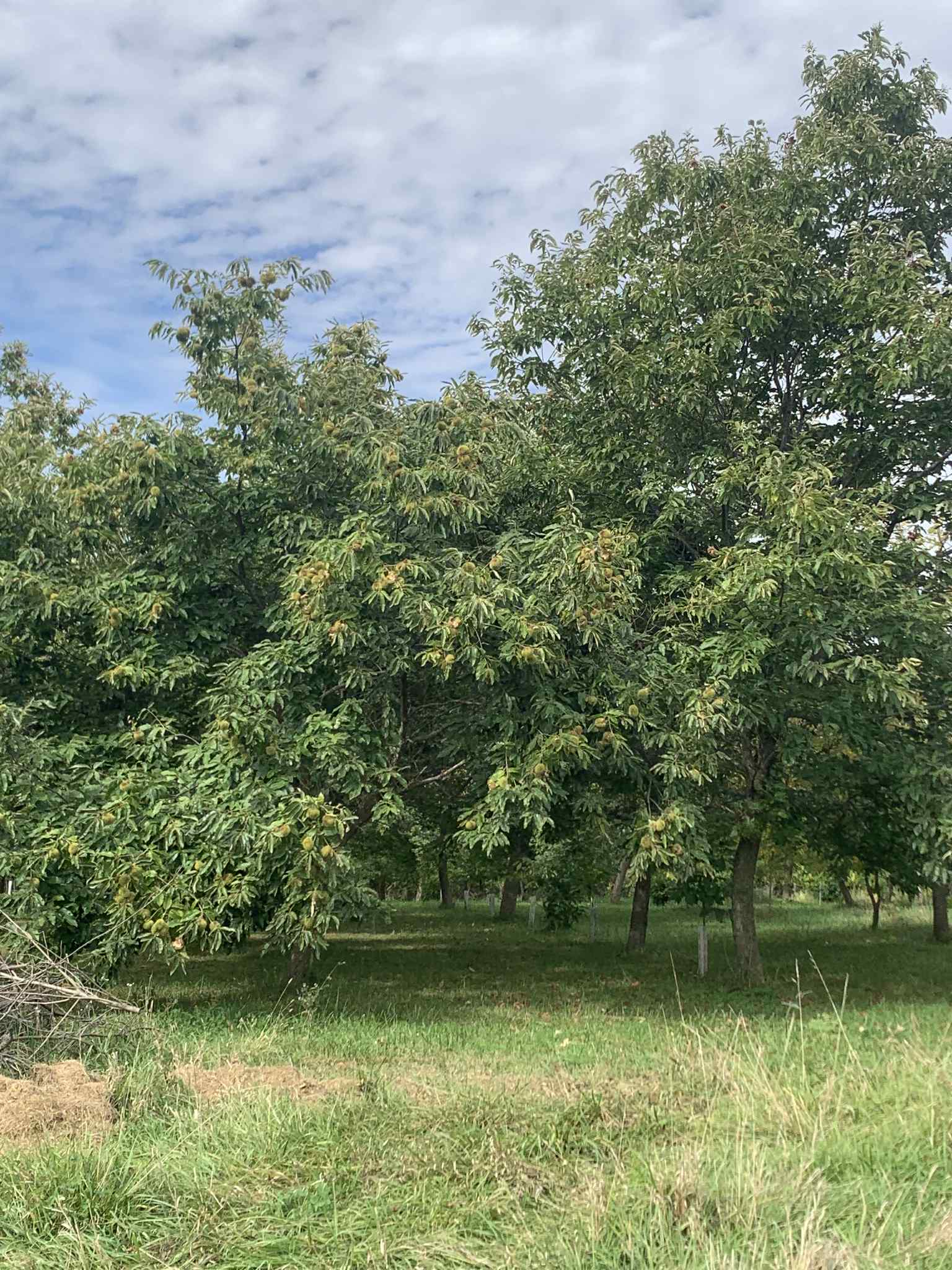
This selected Chestnut breeding population from Red Fern Farm is primarily (85-90% or more) derived from Chinese chestnut trees (Castanea mollisima).
However, in the mix, there is seed from just a few hybrid trees that can include Japanese (Castanea crenata), European (Castanea sativa), and American (Castanea dentata) genetics.
Even in trees that include some genetics other than Chinese, Chinese is still likely at least 50% of those trees or more.
Regardless, all seed is from 'selected' trees on the farm.
And of course, all of these 'selected' trees are open-pollinated in the same orchard, so we only know the origin of the mother tree. The pollen can come from any other tree on the farm.
In this heavily focused Chinese chestnut population, it is half 'Mother' and half 'Up and Coming'.
'Mother' trees are Red Fern Farm trees that have at least ten years of documented large reliable harvests, with other good traits as well.
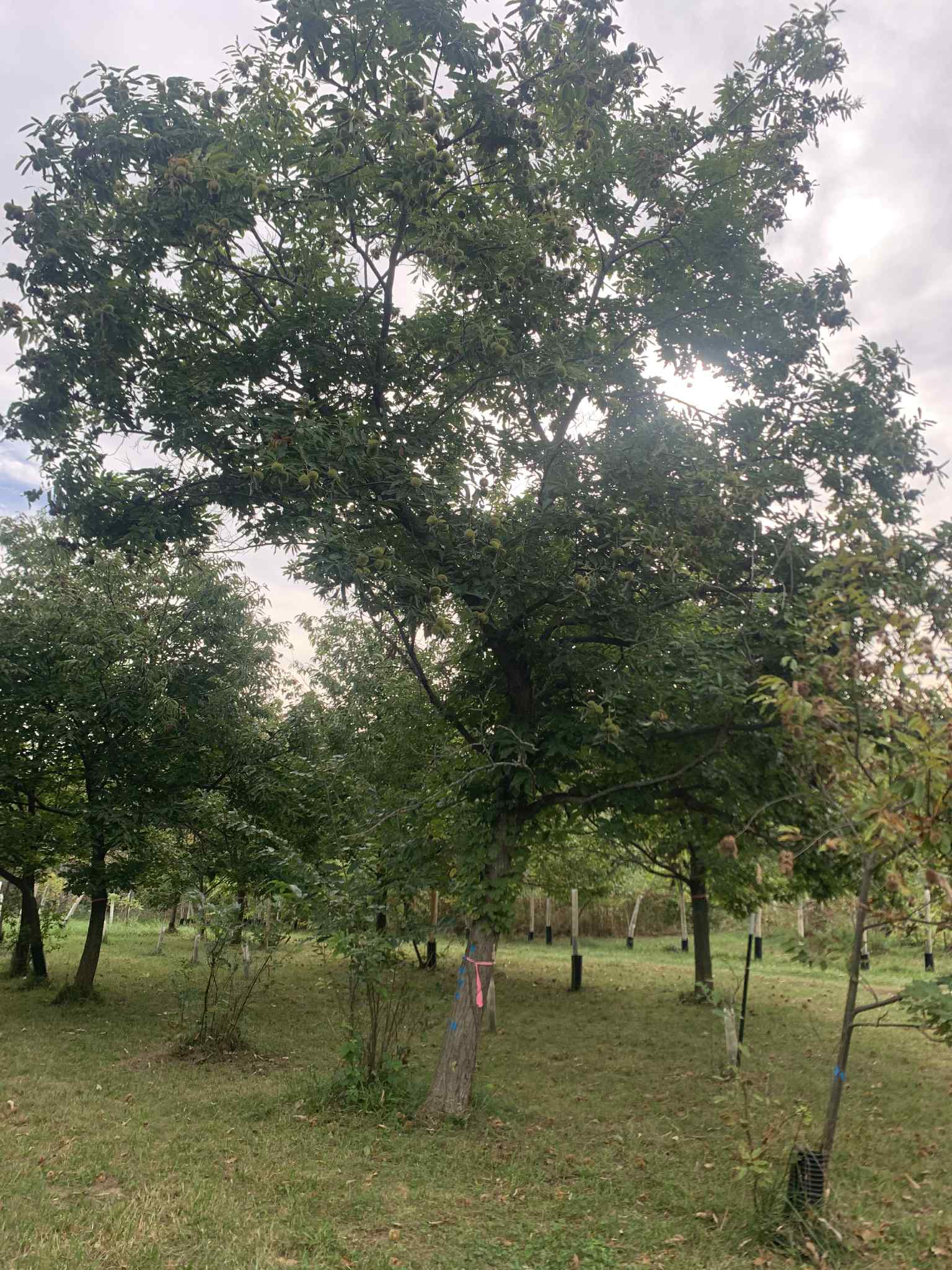
'Up and Coming' trees are trees that came from open-pollinated seeds of 'Mother' trees on the farm. They are the second generation. These trees don't have ten years of data yet, but these trees are well on their way to becoming named 'Mother' trees. After a large crop year, trees get a blue dot mark, as you can see in one of the photos of an 'Up and Coming' tree.
IMPORTANT NOTE: The seeds get combined from each category when we pack them up, to ensure the proper proportions in each order.
Origin: Red Fern Farm, Wapello, Iowa
Improvement status: Breeding population
Life cycle: Perennial
Pricing options:
10 seeds for $22.50 ($2.25 each)
25 seeds for $50 ($2 each)
50 seeds for $87.50 ($1.75 each)
75 seeds for $123.75 ($1.65 each)
100 seeds for $150 ($1.50 each)
200 seeds for $200 ($1 each)
300 seeds for $300 ($1 each)
SHIPPING RESTRICTION NOTICE: Due to quarantine restrictions on chestnuts, we cannot ship these chestnut plants to California, Oregon, and Washington. We are also not shipping them internationally. Orders to these places will be canceled.
A couple years ago, we offered chestnuts from Badgersett Research Farm, and it proved to be a huge hit. This year, in our ongoing quest to make seeds available of the most important sources of various perennial crops, we are very excited to offer these primarily Chinese chestnut genetics from Red Fern Farm, located in Wapello, Iowa.
Run by Tom Wahl and Kathy Dice, Red Fern Farm is one of the best regional examples of a successful diversified tree-crop farm. Kathy and Tom planted their first chestnut tree in 1990, and did their first big chestnut planting in 1992. They made successive plantings in 1997, 2001, and several times more since then. They also grow pawpaws, American persimmons, Asian pears, and heartnuts, among other crops (with Katahdin sheep grazing in between, providing weed control and natural fertilizer). Red Fern Farm primarily sells their produce using a “you-pick” model with all these offerings, though chestnuts are the primary draw.
Red Fern Farm is about 3.5 hours south of Badgersett (Badgersett is in southeast Minnesota, Red Fern is in southeast Iowa). It doesn’t get quite as cold as at Badgersett, but Red Fern’s chestnuts survived the extreme cold of the January/February 2019 polar vortex, so we know their stock is cold-hardy. And in fact, a portion of their chestnut orchard came from Badgersett seeds.
EFN co-founder Dusty Hinz, who is planting several acres of chestnuts in southeastern Minnesota at his family’s farm, is including a sizable portion of Red Fern Farm seedlings in his planting, and he encourages others to do the same. We believe Red Fern chestnuts to be widely adaptable to other locations, particularly all across the Midwest and Northeast of the US, and we imagine they will fare well further south too.
Half of these seeds come from named 'Mother' trees from their original planting. These are mostly derived from seedlings of pure Chinese chestnut cultivars, but also include some hybrids, including Japanese (Castanea crenata), European (Castanea sativa), and American (Castanea dentata). All of these trees have at least ten years of harvest data and have been given names. Seeds in the mix we are offering you came from nine of these impressive trees, most of which have their roots at Greg Miller’s Empire Chestnut Company in Ohio, and some from the Horticulture and Agroforestry Research Center at the University of Missouri.
Half of these seeds come from 'Up and Coming' trees, this category includes trees that descend from 'Mother' trees, essentially the second generation of the best original selections. As you can see in the photo, trees get one blue dot or two blue dots for each year they yield bumper harvests. These trees aren’t old enough to be given names yet, but they look very promising and are well on their way. Seeds in this mix come from eight of these trees.
And, of course, all these trees are open-pollinated, so we know the mother tree, but the pollen could have come from any other chestnut tree at Red Fern. This is a breeding population, or what we could call a “hybrid swarm.” Starting with a broad base of genetics, ongoing selections of the best trees from successive generations yield an improved population maintaining most of the genetic diversity that typified the initial population. We believe planting these three different populations in roughly equal proportion will prove beneficial for overall genetic diversity and long-term adaptability to new bioregions.
The general nut-size for each category is best described as medium to medium-large.
There are some sources out there where you can buy Red Fern chestnut trees, but as far as we know, EFN is the only source for Red Fern Farm chestnut seeds at this time. The only other way to get them would be to go to Red Fern Farm and pick them yourself!
Special thanks to our friend, Levi Geyer, for harvesting these seeds for us. Levi is an employee at Red Fern Farm and he worked closely with us on our order. Levi is also an inspiring young nut-tree guy! He’s a trailblazer in the effort to develop a wild yellowbud hickory oil industry (that’s Carya cordiformis, also known as bitternut hickory, though the bitter tannins are only water soluble, so the oil is non-bitter and delicious). Could be the olive oil of the north! These are just the kind of bioregional perennial tree-based food systems we need to be developing. (You can check out Levi’s hickory oil business here: https://www.fancytwigfarm.com/)
As we enter into an uncertain ecological future beset with volatility from climate change and environmental degradation, it is absolutely imperative for agroforestry practitioners of the world to be trialing trees from genetically diverse populations like these. Diversity means resilience. And resilience means survival. Thank you for doing your part!
More on Tom Wahl:
Before he got into chestnuts, Tom Wahl was a wildlife biologist, forester, and park ranger. He trapped and banded waterfowl, trapped and ear-tagged skunks, raccoons, mice, shrews, and weasels, radio-tracked river otters and pheasants, and planted trees and prairies. He loves being active and outdoors everyday.
Tom set out to prove that agriculture can be practiced — and a farm family can make a good living — on just a few acres, in a way that doesn’t cause soil erosion, use toxic chemicals, or rely heavily upon fossil fuels. Tom believes chestnuts can be part of a more sustainable system than the dominant corn/soybean model. He’s a natural resource conservation professional that got the farming itch.
Tom’s advice to young agroforesters: Keep your day-job until your trees produce enough income to support you.
To hear more from Tom Wahl on everything chestnuts and other stuff, check out this podcast:
https://unitedchestnuts.com/podcasts/live-cga-conference-2023-tom-wahl-red-fern-farm/
Tom has been an active member of the Northern Nut Growers Association for decades. EFN co-founder, Dusty Hinz, attended last year’s (2024) annual NNGA meeting in Syracuse, NY and this year’s (2025) in Lansing, MI. He has been able to get to know Tom more at these gatherings and talk shop. Getting Red Fern’s chestnuts in the EFN catalogue seemed like a good fit. That is Dusty and Tom in the photo.
Two notes on storing and handling chestnut seed:
In order to germinate in the spring, chestnuts need to be kept cool (32-40F) and moist for 2-3 months. The easiest way to do this is to put them in ziploc bags and put them in the fridge. We used to prick small holes in the bags for ventilation, but we found out this is not necessary and just allows them to dry out quicker. They will survive just fine in sealed ziploc bags in the fridge. Do this immediately after receiving your seeds in the mail!! You can add slightly moist (not damp!) peat moss to the bag to help retain moisture, if necessary; this is usually helpful for small amounts of seed. Chestnut seed CANNOT FREEZE! They will die if frozen. You can also periodically soak the nuts in water for 5-10 minutes throughout the winter to re-moisturize them, and then return them back to their bag and put back in the fridge.
Second, chestnuts need to be grown in a rodent-proof situation. This usually means protected by 1/4" hardware cloth, either in a greenhouse or a rodent-proof nursery bed. Do not just plant them directly in the soil without protection, as they will almost always be eaten by rodents or birds.
NOTES ON TREE SPACING AND OTHER PLANTING TIPS:
At Dusty Hinz’s chestnut planting in SE Minnesota, he has done 30 feet between rows with a tree planted every 4 feet within the row. This is a high density planting that he will eventually need to make selections from. But when you do coppice chestnut (cut it down to the ground), it grows back from the roots. So in this scenario, coppice essentially means you are allowing your selected trees to grow up and get bigger, free from their next door competition, but you aren’t necessarily killing the tree next to it, just setting it back.
This high density type of planting is what Badgersett recommends, as there is more variability in the Badgersett population, and the goal is to have a lot of genetics to select from.
At this point, with Tom Wahl’s vast experience, he recommends planting chestnuts on 20 foot centers, so 20 x 20. He also advocates using tree tubes. This is not high density. In this scenario some trees may need to be culled 20 years down the road if they are growing into each other, and you want to allow some to get bigger.
Another planting method Dusty has experimented with, which also seems to work well, particularly in an urban or suburban setting, is planting the trees in groups of 3, with the groups maybe 20 feet apart. Within the group, the three trees could be in a triangle, with each tree about 2 feet apart. If one tree dies, you still have two. This is also good for pollination. The idea is you basically let all 3 trees grow up among each other, as one unit, like a tree with three main stems.
All in all! There is no one right way to do anything. We wanted to share with you these different planting styles. You decide what is best for your situation.
If you’re doing a relatively small planting, it may be wise to use tree tubes or other DIY hardware cloth wrap-around cages. If you’re doing a large planting, say hundreds or possibly thousands of trees, you may be playing the numbers game, and the cost of a tree tube for each tree may not be practical or efficient, as they do require extra maintenance.
You may also consider looking into 3D deer fencing, which Dusty as well as the Savanna Institute have found to be effective. We recommend 3D deer fencing materials from Premier 1 Supplies.