Dracaena draco
Origin: Canary Islands via California
Improvement status: Unknown
Seeds per packet: 10
BOTANICAL SAMPLE - NOT GERMINATION TESTED
Life cycle: Perennial
Along with its cousin, the Socotra Dragon's Blood Tree (Dracaena cinnabari), from an island on the other side of Africa, the Canary Islands Dragon's Blood Tree is one of the major sources of the historically important red-colored resin known as "dragon's blood." Long used as a dye, painting pigment, varnish, incense, toothpaste, and ingredient in compounds both medicinal and magical, the garnet-red sap — which drips like slow-moving blood from any wounds to the plant's bark — has captured imaginations for thousands of years. Since the major sources of the resin were largely found on isolated islands, it was apparently easy for its marketers to pass it off as genuine dragon's blood — for few had firsthand evidence to dispute such tales. It is first mentioned (with the now-anonymous author acknowledging it comes from a plant) as a product of Socotra in a 1st century Greco-Roman periplus, a sort of first-hand travel and trading guidebook, called Periplus Maris Erythraeixi, which detailed economic opportunities for travelers and traders from the Red Sea across the Arabian Sea to modern-day India, almost all the way to Bangladesh (and including an overland route to China as well).
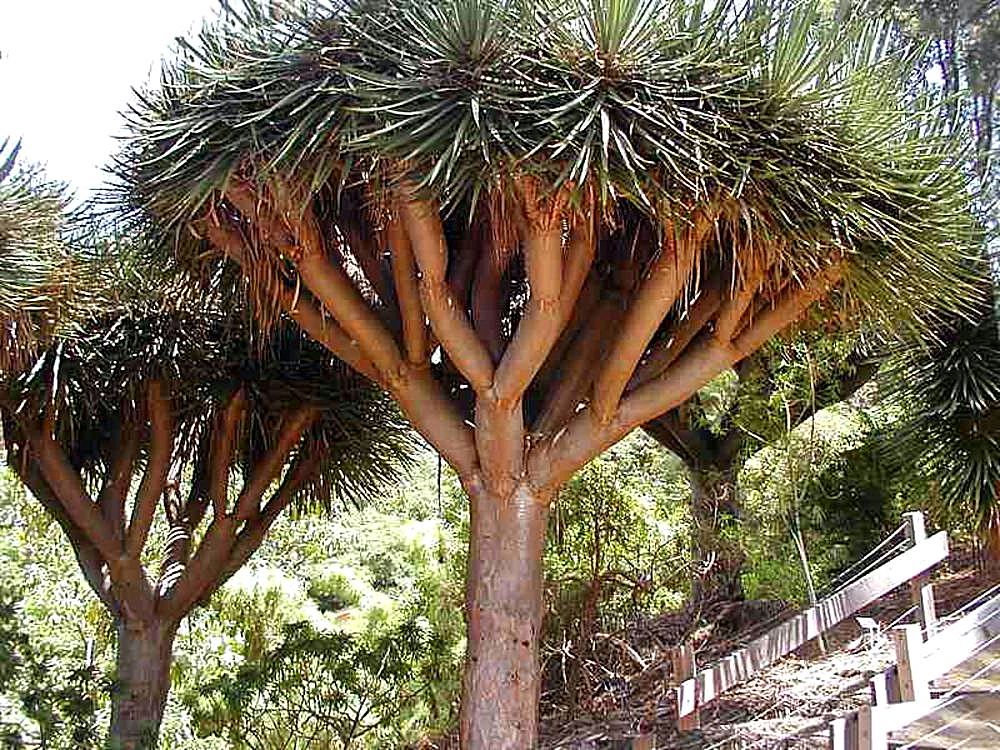
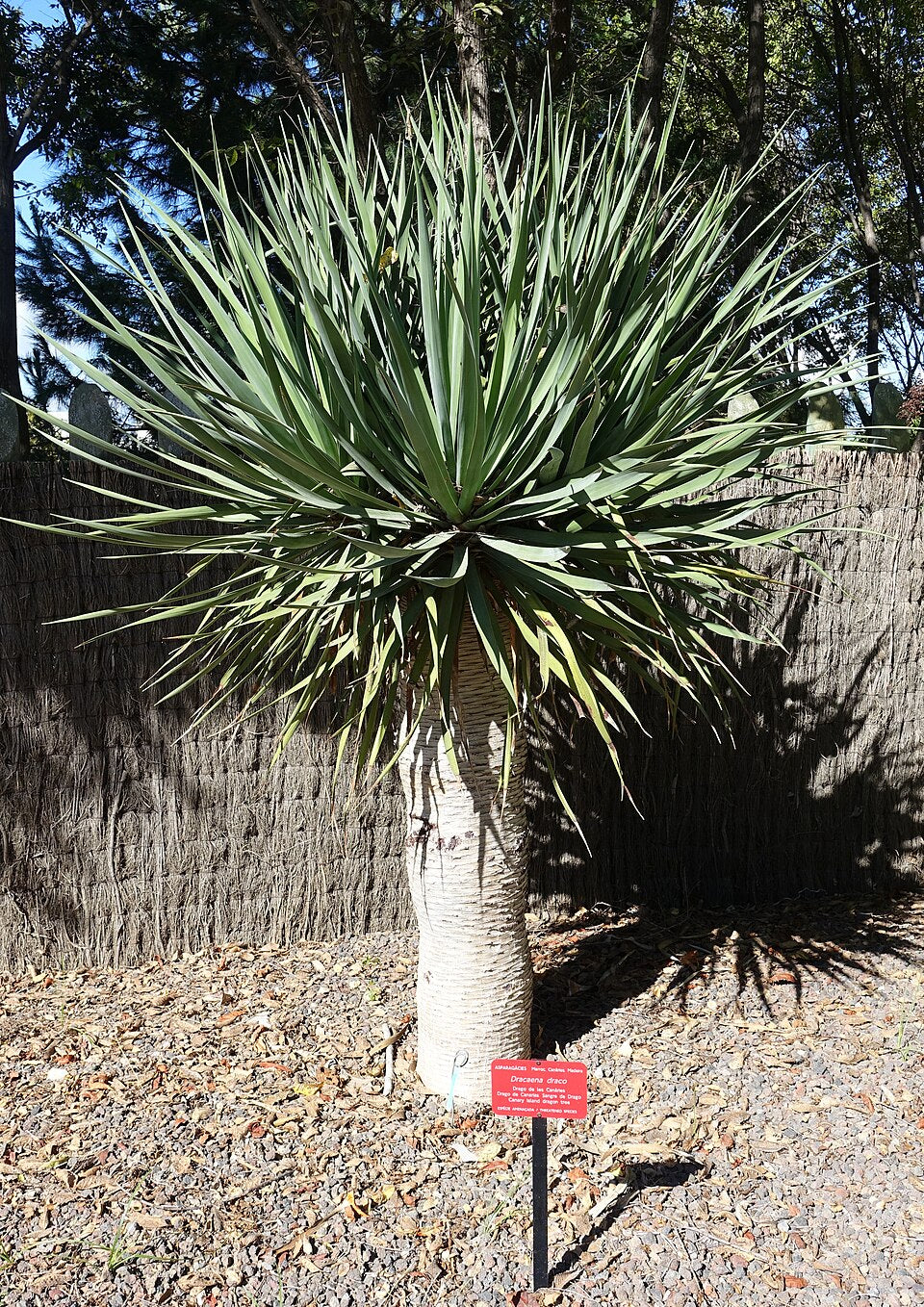
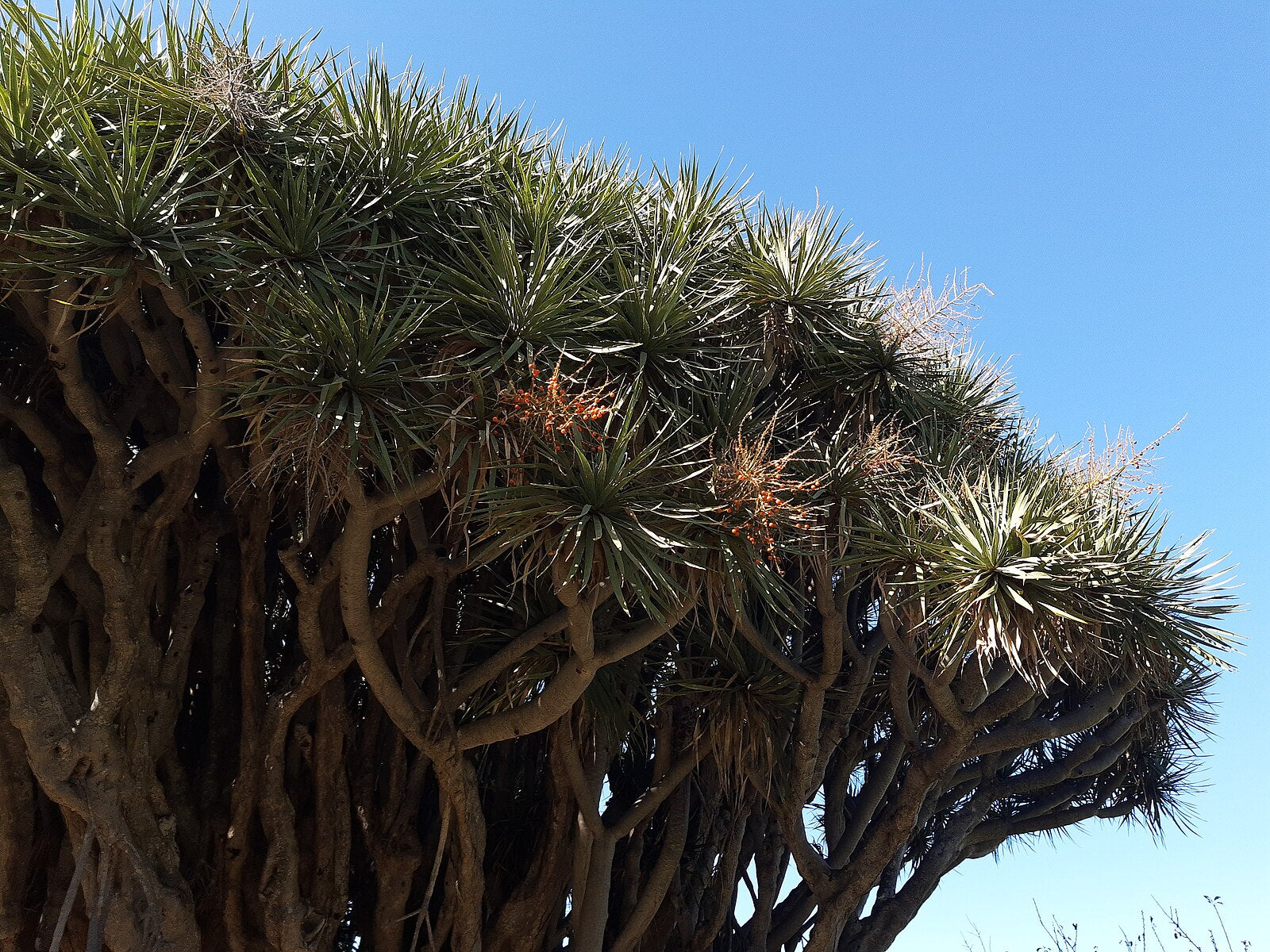
This species, Dracaena draco, which not only is native to the Canary Islands, but also Cape Verde (Cabo Verde), Madeira, and a few places in western Morocco, is usually called the Canary Islands dragon tree or dragon's blood tree, or just drago. Early Portuguese introductions from Cabo Verde are believed to have given rise to the small population that still exists in the Azores as well. When the Swedish father of taxonomy, Carl Linnaeus, described the tree in 1762, he called it Asparagus draco — and indeed it is still placed in the Asparagaceae family. But this tree is no simple asparagus. It has a very distinctive growth form: young trees grow upward as a single stem topped by a dense crown of long, yucca-like leaves; then after ten years or so, the first pretty white flowers form (looking somewhat like lilies), followed by orange-red fruits; then a crown of buds forms and the plant begins to branch; each branch grows for another decade or so, then also flowers and branches again, in a process repeated over hundreds or thousands of years until the tree has a large, strong, woody trunk, topped with a maze-like crown of interlocking branches topped with a hemispherical crown of green leaves, flowers, and fruit. The oldest, largest individuals are stunning to see.
When the German naturalist and explorer Alexander von Humboldt visited the Canary Islands in 1799 he was shown a massive drago specimen in Tenerife that had been hollowed out by the indigenous Guanche people and used as a sanctuary long before the arrival of Spanish imperialist colonizers. The tree was 70 feet tall (21 meters) and 45 feet in circumference (14 meters) — and estimated to be 6,000 years old. Sadly, it was felled in a storm in 1868.
The resin from this species differs slightly from the resin of the Socotra dragon tree (which was known to Europeans for a millenium and a half longer), but upon its "discovery" in the 1400s, it began being used as a slightly more accessible substitute. It became particularly important as a varnish for the beautiful violins produced in Italy during the time of Stradivarius and his successors. There is little record of how the indigenous Guanche people (related to mainland Northern African Berber peoples), who arrived in the islands by the 6th century BCE, utilized the plant — because most of them were killed or died of exposure to novel diseases in the decades after Spanish conquest began (the language went extinct sometime in the 1600s) — but its likely they found many uses for it as well, as the local inhabitants of Socotra use theirs.
Today, dragon's blood is still used medicinally — primarily for wound healing, digestive issues, and pain relief — with scientists continually probing it for more uses. Modern research has found potent antioxidant, antibacterial, antiviral, anti-inflammatory, and wound-healing properties, validating its traditional uses, and studies note few negative side effects. Bioactive compounds in the plant show promise in the treatment of diabetic wounds, cardiovascular disease, and even cancer.
In most of the US, the tree can only be grown as a houseplant (and many people have very long-lived dragon's blood trees growing in pots, rarely growing taller than 4 or 5 feet over 50 years), but it can tolerate life outdoors in much of USDA Zones 9 to 12. It can tolerate brief dips below freezing, but prefers temperatures to stay above 50°F.
This California-grown seed comes to us from the good folks at Sheffield's Seed in Locke, New York.
GROWING TIPS: To germinate, soak seeds in hot tap water and let sit for 24-48 hours. Sow 1/4 inch deep, keeping soil warm (above 75°F) and moist, but not over-saturated. Seeds should sprout within 4-6 weeks. For potted plants, use regular potting soil in inividual pots. Put them in bright, indirect light. Do not leave roots wet. Trees grow in places that often see very little rain, so using a humidifier to keep your air more humid is sometimes best. You could also use the ice-cube method, placing a few ice cubes on top of the soil (away from the base of the plant) every week or two, to make sure you don't over-water them.
NOTE: The image of the old tree with the door in its trunk, comes from the Wellcome Collection, a website operated by Wellcome Trust, a global charitable foundation based in the United Kingdom. It is shared under the Creative Commons Attribution 4.0 International license. The image of dragon's blood resin may or may not come from this species, but all of the resins look similar (it may be Dracaena cinnabari, as the author believed, or Calamus draco, an unrelated species which produces a similar-looking resin, or Dracaena draco). It is from author Maša Sinreih in Valentina Vivod and is shared under the Creative Commons Attribution-Share Alike 3.0 Unported license. All others are public domain images of Dracaena draco.